


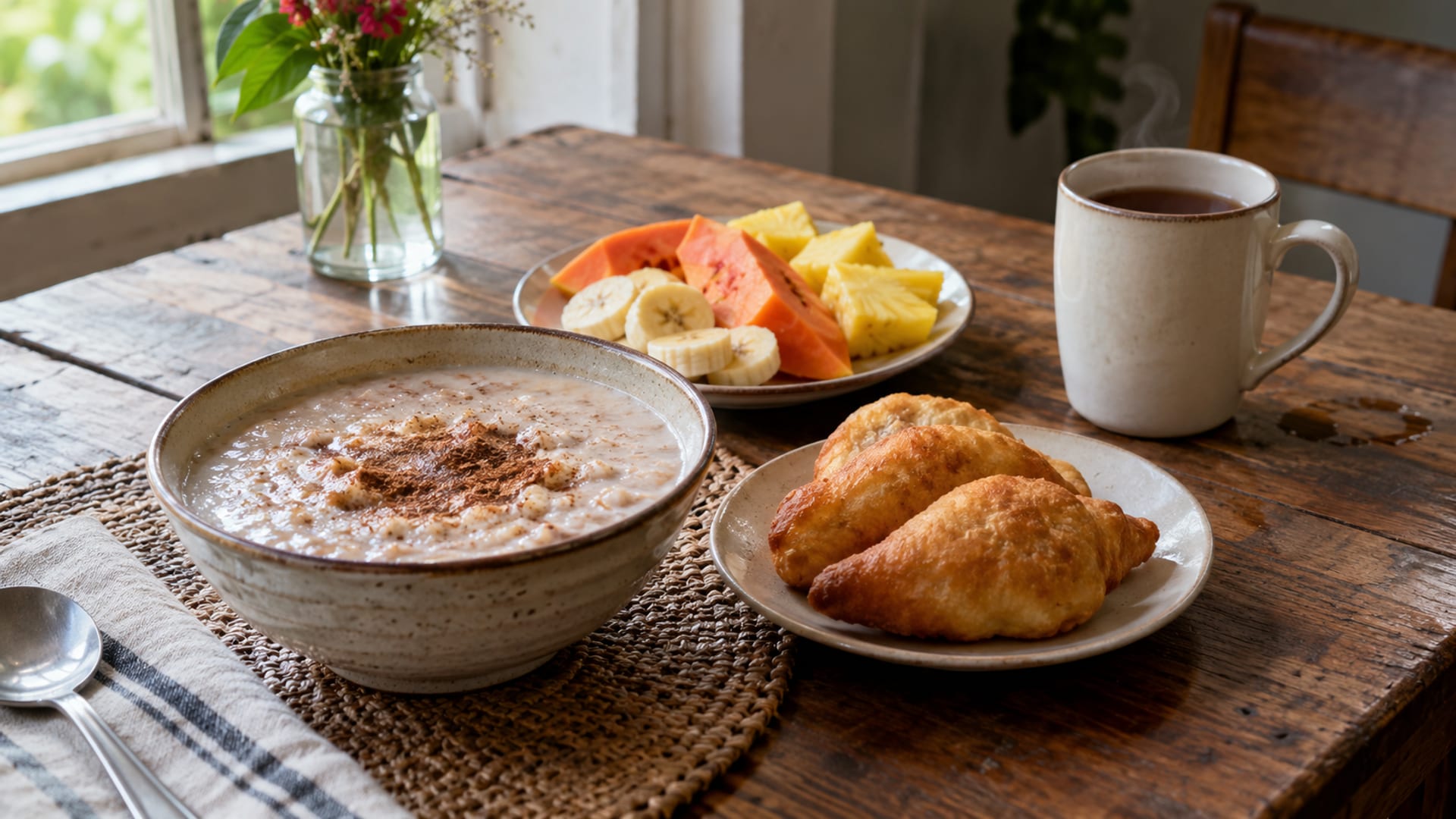
Jamaican breakfast is not one fixed plate. It can be a full cooked meal built around ackee and saltfish, callaloo and saltfish or salt mackerel rundown, or something lighter, like a bowl of porridge with hard dough bread and tea. Which one you get depends on how much time you have, whether it is a weekday or a Sunday, and where you are eating. You can get it at a roadside cookshop, a porridge vendor, a sit-down restaurant, a patty chain or a hotel breakfast.
What goes on the plate
Ackee and saltfish is Jamaica's national dish, and it is a major breakfast choice. The ackee is cooked with salted codfish, usually after the fish has been soaked or boiled to take out some of the salt. The mix is seasoned with onion, tomato, sweet pepper, thyme and Scotch bonnet pepper. It usually comes with fried dumplings, boiled green bananas, yam, plantain, callaloo, avocado, bammy or breadfruit.
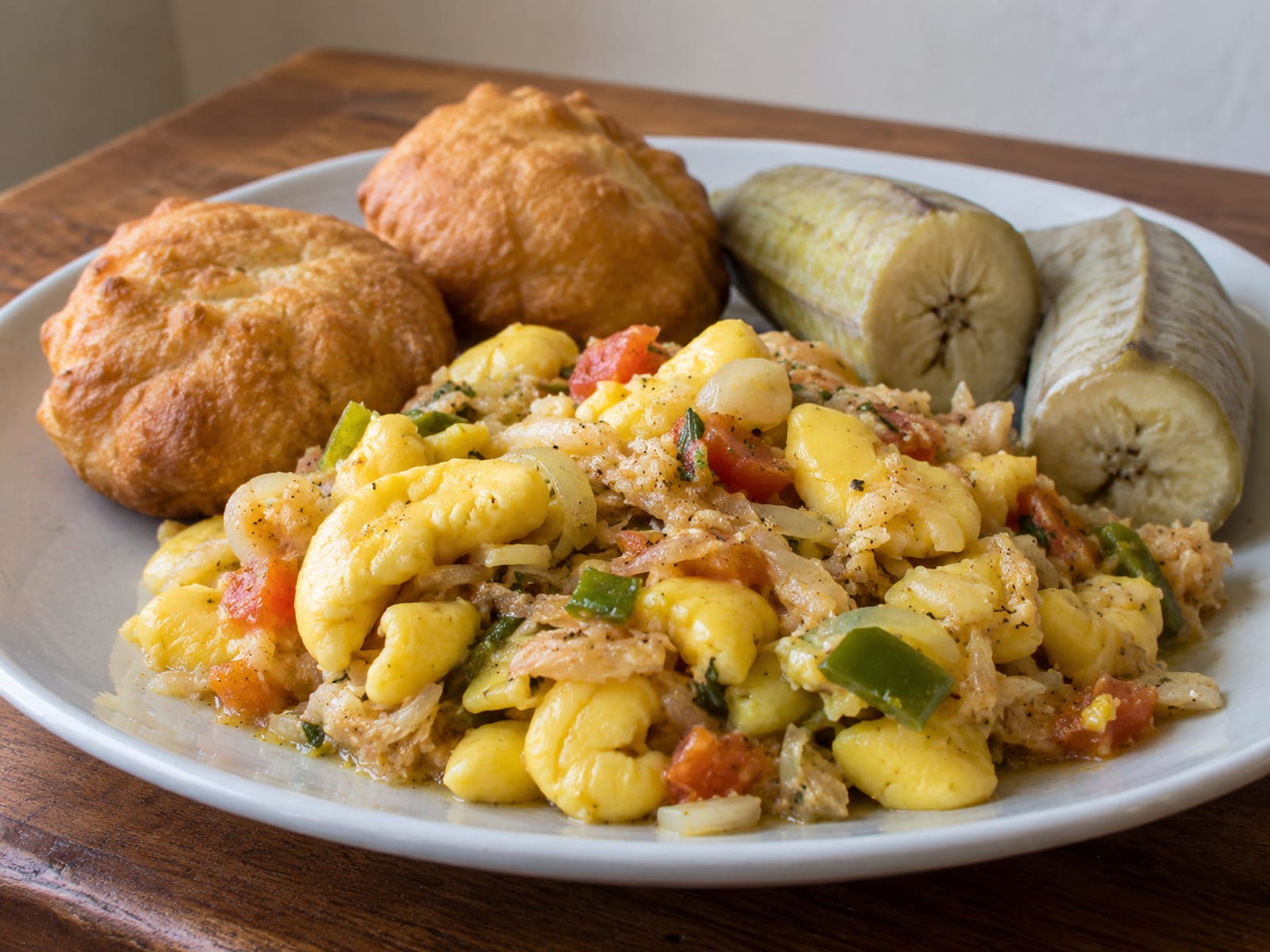 Ackee and saltfish usually comes with fried dumplings, boiled green bananas, yam or plantain.
Callaloo and saltfish is the other big cooked plate. Callaloo is a leafy green, and cookshops commonly sell it alongside saltfish and the other staples. Mackerel rundown is salted mackerel cooked in reduced coconut milk with herbs and spices, and it is usually served with boiled green bananas. Saltfish is also cooked with vegetables such as cabbage, okra or broad beans, and some households serve liver with bananas or other provisions.
Fried dumplings, also called Johnny cakes, often come with saltfish or another breakfast dish. Boiled green bananas, yellow yam, sweet potato and breadfruit fill out the ground provisions. Some households also serve roast breadfruit, saltfish fritters, bammy, escoveitch fish or stew chicken in the morning.
The simpler breakfast is bread and butter with tea. Hard dough bread is sometimes served with hot chocolate made from Jamaican cocoa, and tea, coffee, fruit juice and other hot or cold drinks round out the table.
Porridge, the everyday option
Porridge is a common quick breakfast, and it comes in more varieties than most visitors expect. The common types are cornmeal, peanut, hominy corn, green banana, plantain, oatmeal and banana, and mixed porridges such as peanut, plantain and cornmeal together are common too. Cornmeal is often seasoned with cinnamon, nutmeg and vanilla. Hominy corn is often finished with coconut milk, condensed milk, vanilla, cinnamon or nutmeg. The milk itself can be coconut, condensed, evaporated, powdered or dairy.
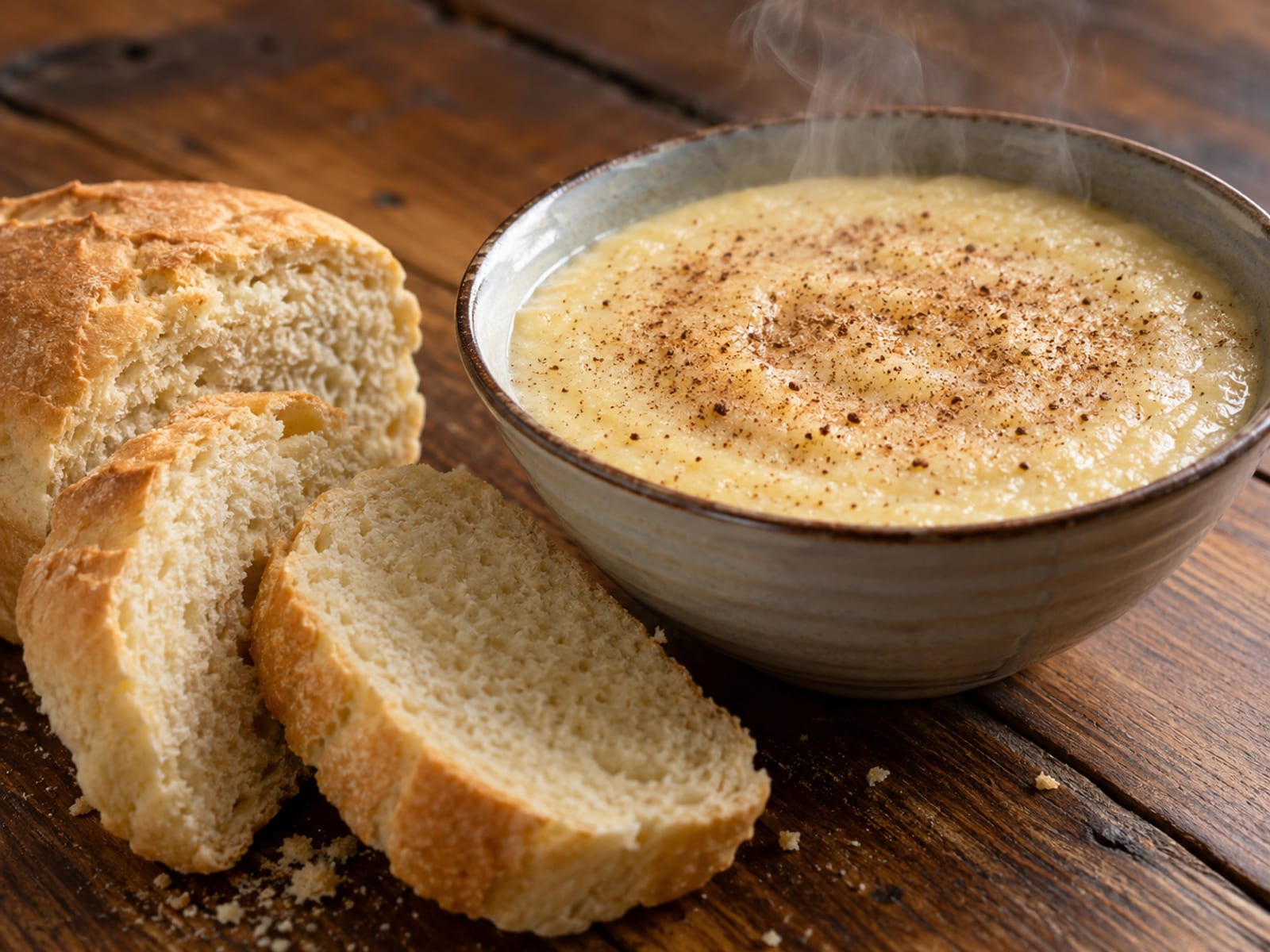 Porridge is usually hot, sweet and thick or creamy.
Porridge is usually hot, sweet and thick or creamy, although the texture depends on the cook. It may come in a cup or a bowl, and it is often eaten with bread, crackers or another small side. For where to get a cup, see Jamaican porridge and where to get a cup.
Some vendors keep a rotating menu. In 2015, a Jamaica Observer report described a May Pen vendor who served cornmeal and plantain on Mondays, banana and hominy corn on Tuesdays, plantain and hominy corn on Wednesdays, and peanut and hominy corn on Thursdays, Fridays and Sundays. The pattern is useful even today: if you want a particular porridge, ask what is on that day.
Prices for porridge can be small. On a Montego Bay street cart, Eat Your World recorded peanut and hominy corn porridge at J$130 for a small portion and J$250 for a large one in a 2025 article (about US$0.82 and US$1.57). The cart keeps no set hours, so confirm before you go.
Where to get breakfast
Breakfast is served from several kinds of places, and each one trades off choice, price and timing a little differently. The sections below cover the main options.
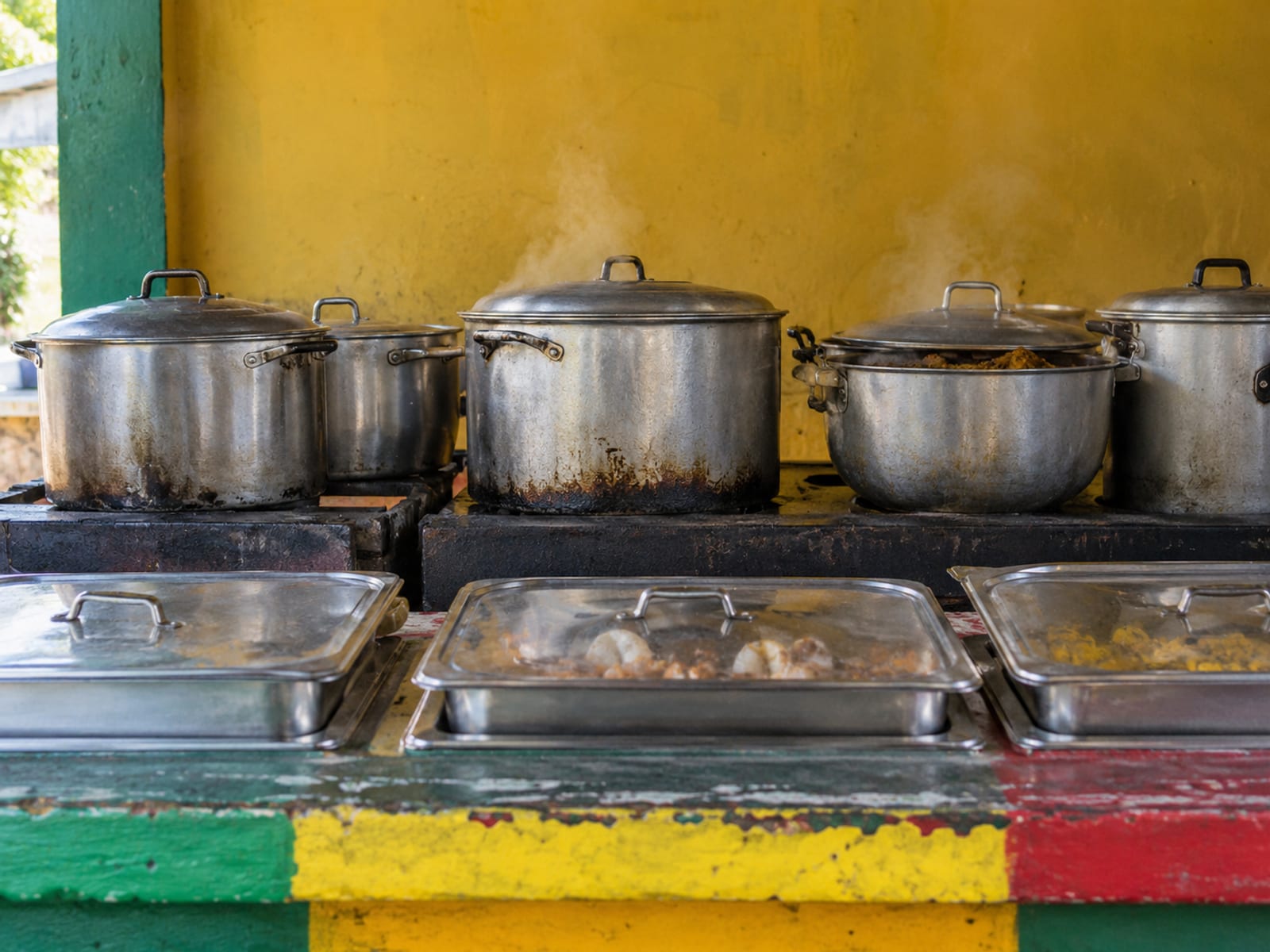 Cookshops and small vendors are a direct route to a full plate.
Cookshops and small local vendors
Cookshops and small food vendors commonly sell cooked plates, porridge, dumplings, callaloo, saltfish and ground provisions. They are a direct route to a full plate. Ask what time breakfast stops, and whether the dish you want can sell out.
Porridge vendors and street carts
Porridge vendors and street carts are most common in busy town centres. A Jamaica Observer report from 2015 described a May Pen vendor who began selling around 7 a.m. and often sold out by noon. If you want the full choice, go early.
Independent restaurants: Homar's Roti and Grill, Clarendon
Homar's Roti and Grill is a sit-down option in Mineral Heights, Clarendon, at Lot 22 Mineral Heights Commercial Complex. Its menu covers several of the classic plates, from porridge to ackee and saltfish and mackerel rundown. Its menu, as listed in October 2026, includes peanut porridge at J$250 to J$780 (about US$1.57 to US$4.91), plantain porridge at J$200 to J$780 (about US$1.26 to US$4.91), callaloo and saltfish at J$900 (about US$5.66), ackee and saltfish at J$1,200 (about US$7.55) and salt mackerel rundown at J$1,100 (about US$6.92).
The porridge prices are a range, so ask which size each price covers. The listed hours are Monday to Friday, 7:30 a.m. to 7 p.m., and Sunday, 7:30 a.m. to 8 p.m. Ask about Saturday hours, and ask whether the restaurant takes cash, cards or mobile payment. You can find more places in Clarendon through the directory.
Patty and fast-food chains
Some fast-food and patty chains have offered breakfast too. A 2009 Jamaica Gleaner report said Island Grill introduced a breakfast menu across nine outlets, including ackee and saltfish, callaloo, cornmeal porridge, hominy porridge, stew chicken, fish and bammy. That was 2009, so check with the chain for what it serves now before you plan around it.
Hotels and resorts
Hotels and resorts may put Jamaican breakfast dishes next to eggs, toast, fruit, coffee and international options. If you are staying at an all-inclusive, look for a local dish on the breakfast menu before you go out for one. For more ideas beyond the resort, read Eating Outside Your All-Inclusive: Local Food Near Negril, MoBay and Ochi Resorts.
Guesthouses, caterers and villa kitchens
Guesthouses, caterers and villa kitchens may prepare breakfast by arrangement. Ask early, and tell them what time you want to eat and which dishes you are interested in.
Weekday and Sunday breakfast
Weekday breakfast is usually shaped by work, school and travel time. It may be a quick bowl of porridge, tea with bread, a patty, a sandwich or a breakfast bought from a vendor on the way in. A full cooked plate is also available, but timing matters. A Jamaica Observer report described workers buying porridge from a mobile vendor during the morning rush, where some offerings were only available for a short window.
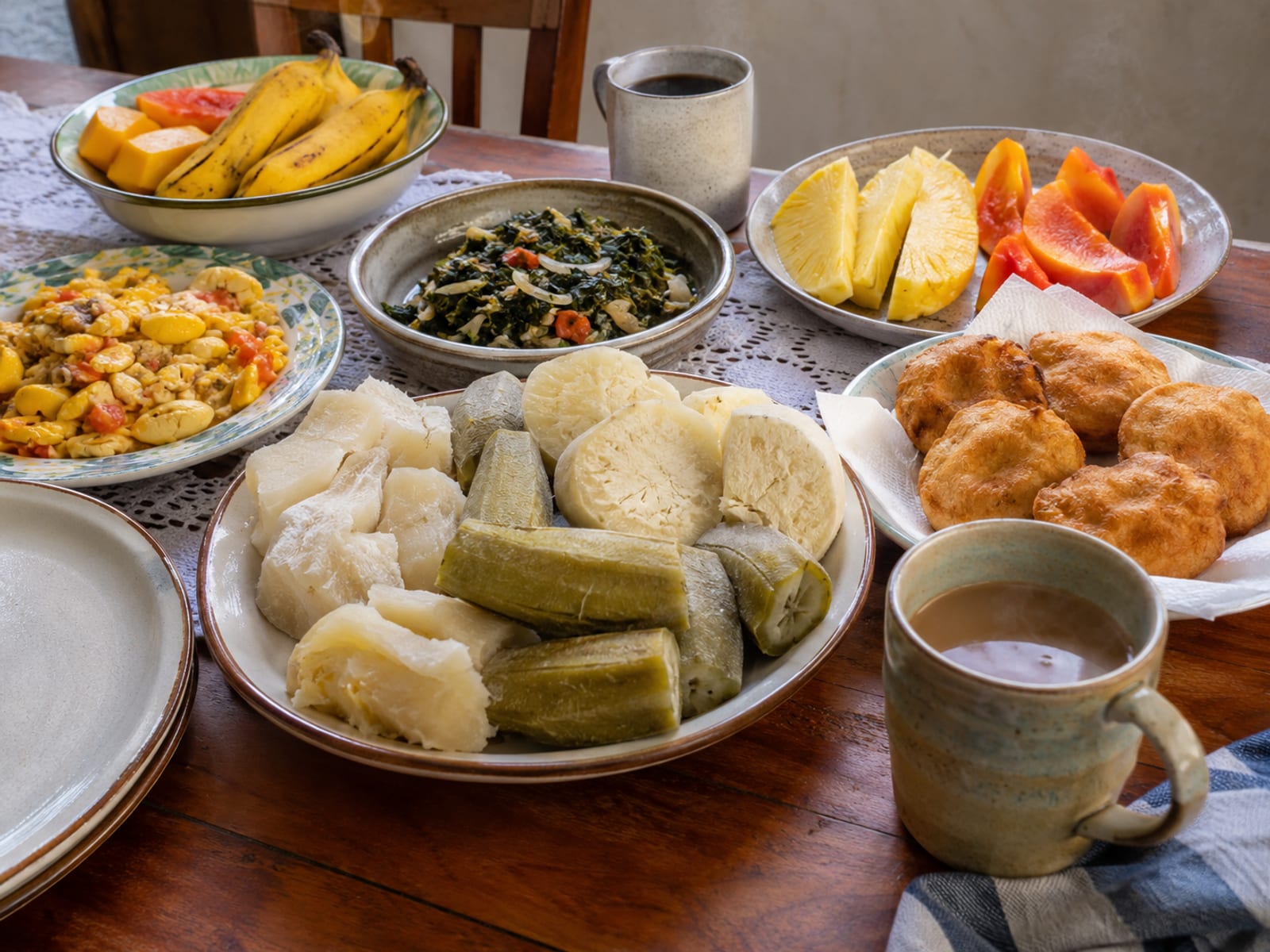 A Sunday breakfast table is usually slower and fuller.
Sunday breakfast is more likely to be a slower, fuller meal. Ackee and saltfish, callaloo and saltfish, fried dumplings, boiled bananas, yam, plantain, bammy, breadfruit, mackerel rundown and hot drinks are all associated with a substantial Sunday table. Family meals and sitting down together are part of the tradition that Jamaican food writers describe.
This is a pattern, not a rule. Some people eat a full breakfast on weekdays, and some eat porridge or bread on Sundays. Restaurant and vendor hours can also change on a Sunday, so check the day you plan to go.
What to ask before you order
Breakfast hours are short and menus can change by day, so a few questions save a wasted trip:
Carry Jamaican dollars as a backup, because not every breakfast spot takes cards.
Common questions
These are the questions readers ask most often about Jamaican breakfast.
What do Jamaicans eat for breakfast?
Common choices include ackee and saltfish with dumplings, callaloo and saltfish, cornmeal or peanut porridge, mackerel rundown, saltfish with cabbage and hard dough bread with butter and tea. Breakfast can be homemade, bought from a cookshop, taken from a patty chain, served by a hotel or bought from a street vendor. The meal changes with the time, the place and the household.
What is a traditional Jamaican breakfast?
There is no single fixed plate. A full version pairs a protein or vegetable dish with a starchy side and a drink, such as ackee and saltfish with fried dumplings and boiled green bananas. A lighter traditional breakfast is a bowl of porridge or hard dough bread with tea.
Where can I find Jamaican breakfast near me?
"Near me" depends on where you are, so search by parish or town. A search such as "Jamaican breakfast in Clarendon" or "porridge in May Pen" will turn up more useful results than a general search. Once you have a place, check the address, the opening time, the breakfast cut-off, the price and the payment method before you go.
What is the national dish served at breakfast?
Ackee and saltfish is Jamaica's national dish, and it is commonly served at breakfast. The ackee is cooked with salted codfish, seasoned with onion, tomato, sweet pepper, thyme and Scotch bonnet pepper. It is not the only traditional breakfast, and not everyone eats it every morning.
What are the main Jamaican porridge types?
The common types are cornmeal, peanut, hominy corn, green banana, plantain, oatmeal and banana porridge, and mixed porridges are common too. Cornmeal is usually seasoned with cinnamon, nutmeg and vanilla, while hominy corn is often finished with coconut or condensed milk. Porridge is generally hot and sweet, and it is often eaten with bread or crackers.
For more of the dishes you will see on Jamaican menus, read Jamaican Food to Try: 25 Dishes and Where to Find Them. To find breakfast places by parish, use the Weh Fi Nyam restaurant directory.