


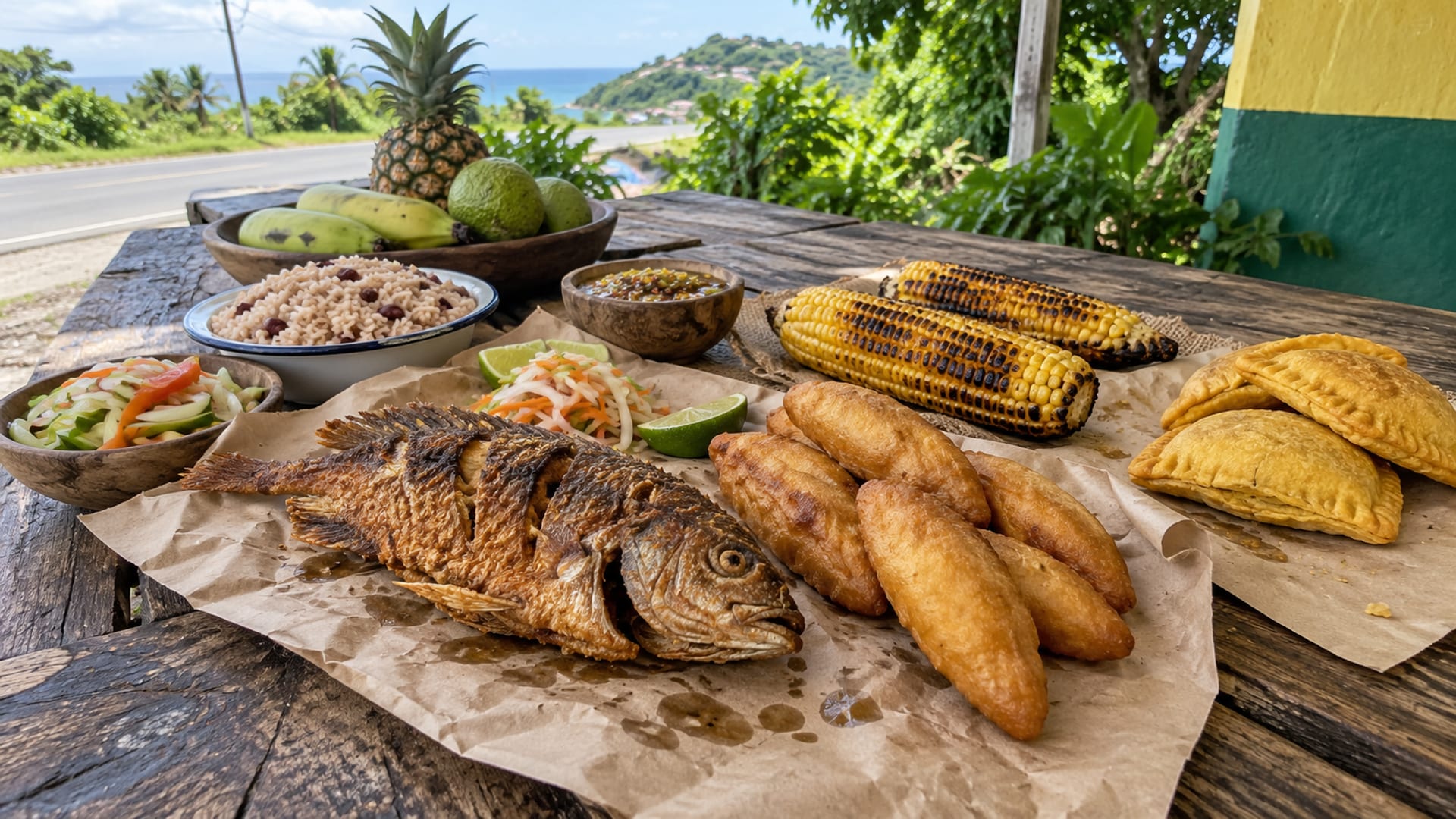
Jamaican street food is the food you buy from a roadside pan, pot, stall or patty counter, and then eat on the spot or take away. The core list is jerk chicken or pork cooked over pimento wood, a beef patty folded into coco bread, roast corn, roast yam with saltfish, fried fish with festival, and pepper shrimp sold in a clear plastic bag. Fresh coconut water and sky juice are the usual cold drinks to go with them.
Much of it runs on cash, and a lot of it is hot. Carry Jamaican dollars in small notes, find out the price before you order, and check that a well-known stop still has vendors before you plan a trip around it.
The foods to try first
- Jerk chicken or jerk pork. The chicken is marinated with seasonings that include Scotch bonnet, thyme and pimento, then cooked over sweetwood or pimento wood. Pimento-wood smoke is the defining feature of authentic jerk, so a pit or pan that cooks over wood is the one to look for.
- A beef patty with coco bread. Patties are half-moon pastries filled with seasoned beef, chicken, vegetables or cheese. Visit Jamaica calls the patty a staple and a must-try food, and patty shops and bakeries often serve it with coco bread.
- Roast yam with saltfish. Yellow or white yam is roasted and served with saltfish. It is a classic roadside plate.
- Fried fish with festival. Festival is a sweet fried dough made from cornmeal and flour, and it is the usual partner for fried fish. Look for the combination at beach and fishing-village food spots.
- Pepper shrimp or river crayfish. The shrimp or crayfish are heavily seasoned, often with Scotch bonnet, and sold in clear plastic bags. Middle Quarters in St Elizabeth is the best-known roadside spot for them.
- Roast corn and boiled corn. Roast corn is cooked over charcoal and sold at roadside stalls and rest stops. Boiled corn comes out of roadside pots, sometimes next to the roast corn and roast yam.
- Ackee and saltfish. This is usually a breakfast dish rather than street food, but it is one of the country's defining foods. It comes with traditional sides such as fried dumpling, callaloo, green banana, plantain or yam.
- Ital food for a plant-based meal. Ital is a Rastafarian-influenced style that uses fresh foods and generally avoids meat and added salt. For more on it, read where to eat Ital food in Jamaica.
Quality, availability and regional style vary from one vendor to the next, so judge each stall on the day.
Where to find it
Roadside food turns up in a few predictable places. You will see it beside the road at intercity rest stops, at beach and fishing villages, near bus stops and traffic intersections, at parish markets and in evening food courts. Roast corn is common at the rest stops, and fried fish with festival belongs to the beach and fishing-village spots. For the other fish plates you will meet, see Jamaican fish dishes and where to order them.
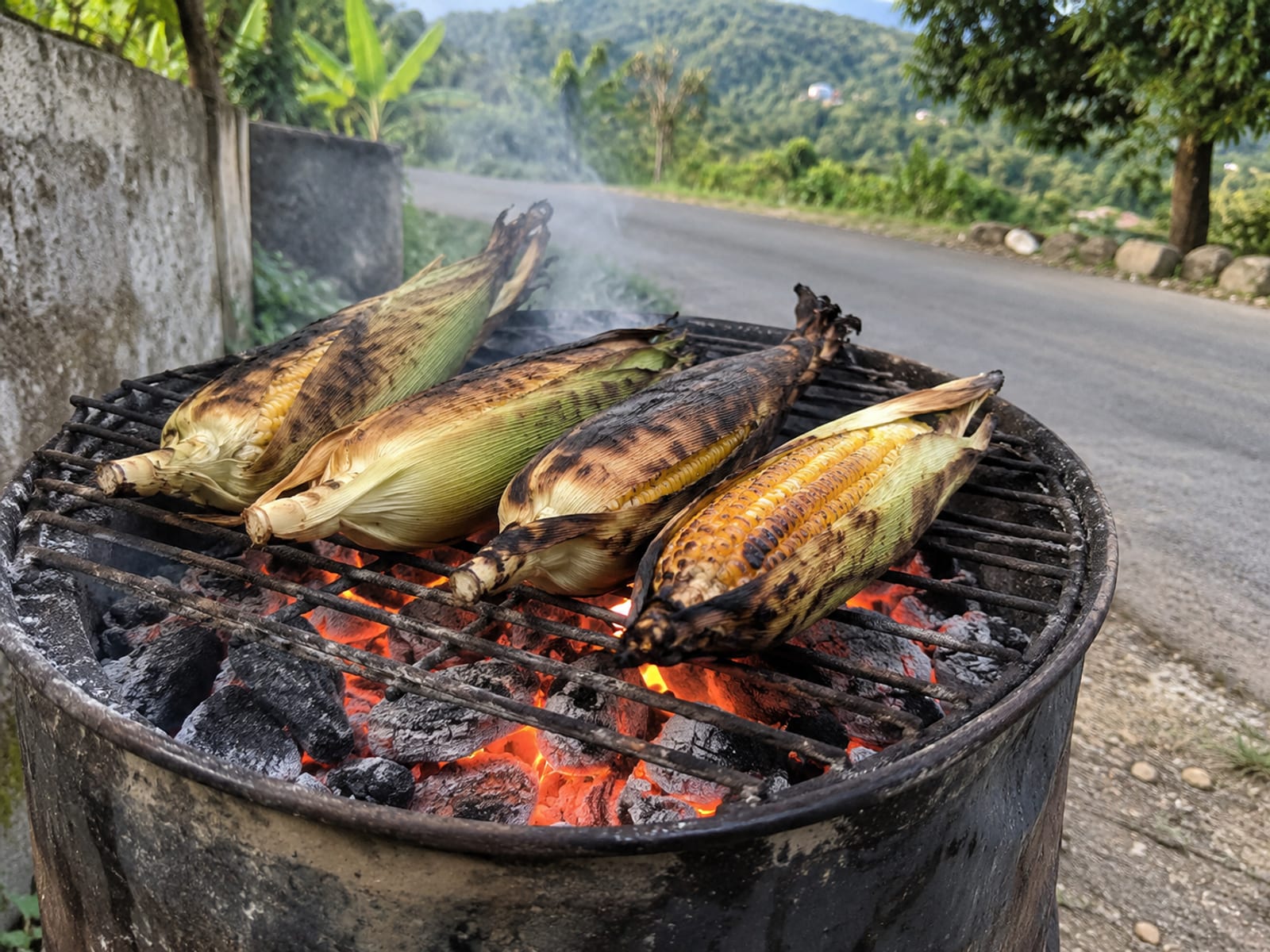 Roast corn is common at intercity rest stops.
Red Hills Road in St Andrew has been a major roadside jerk area in Kingston. Vendors come and go, so check which stands are open when you go. For sit-down places in the same parish, browse the St Andrew restaurants.
Jerk chicken and pork: where it comes from
Jerk chicken and pork are most strongly associated with Boston in Portland, and Visit Jamaica promotes Boston as a major jerk destination. Pan chicken, the jerk-pan version, is sold across the island, so you do not need to travel to Portland to taste it. Boston sits in Portland, and the wider jerk story is in the Boston Bay jerk guide.
Boston has also had public-health problems. Health authorities ordered the Boston Jerk Centre closed on September 6, 2024, after breaches involving sanitation, the jerk pit, washing facilities and food-handler permits. That closure is a reminder that a famous stop can still fail basic checks. Confirm before you go whether the centre has reopened and which vendors are cooking.
For what jerk chicken costs, see the jerk chicken price post.
Pepper shrimp in Middle Quarters
Middle Quarters is a village in St Elizabeth, near the Black River Morass and the YS River. It is famous for pepper shrimp and crayfish sold in clear bags along the road, and the shrimp are heavily seasoned, often with Scotch bonnet. Pepper shrimp is strongest as a regional snack in St Elizabeth, and Middle Quarters is the best-known place to buy it.
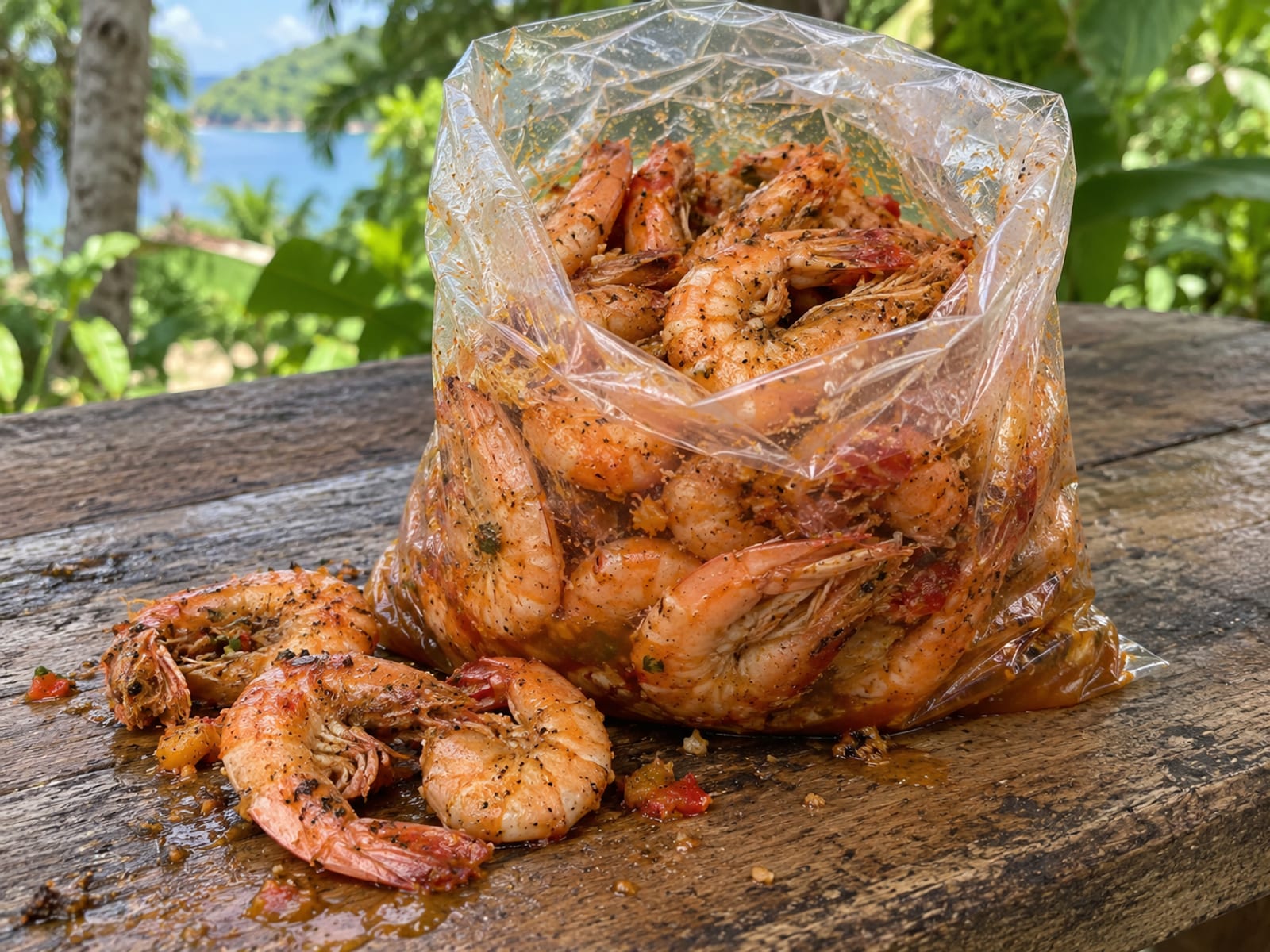 Pepper shrimp is sold in clear bags along the road in Middle Quarters.
The Jamaica Observer reported in March 2025 that vendors were selling mixtures of native soft-shell river shrimp, sea shrimp and the invasive Australian red-claw crayfish, because the native river shrimp catch had declined. That is why it helps to ask what the bag holds. A bag may be river shrimp, sea shrimp or crayfish, and each one can be sold as pepper shrimp.
Plan the stop with the Middle Quarters pepper shrimp guide and the St Elizabeth restaurants.
Patties, bun and cheese, and the snacks in between
Patties are the most widely available snack across the island. Patties are inexpensive and available at any time of day. Lonely Planet notes that the fillings now include beef, chicken, vegetables, soy and ackee.
Bun and cheese is a spiced bun usually eaten with a slice of processed cheese. It is especially linked to Easter, but bakeries and shops sell it more widely. Other snacks you will see include peanuts, peanut cake and peanut-based drinks, roast and boiled corn, roast yam with saltfish or butter, and festival with fried fish. Some vendors also sell seasonal fruit, fried dumpling and saltfish fritters where they are available.
For more on the snack side of the menu, see the Jamaican snacks guide and the Jamaican patties guide.
Drinks from the roadside
Coconut water is the liquid inside a young green coconut. Some vendors open the coconut so you can also eat the soft flesh, and when that flesh is eaten, the coconut is often called a jelly coconut.
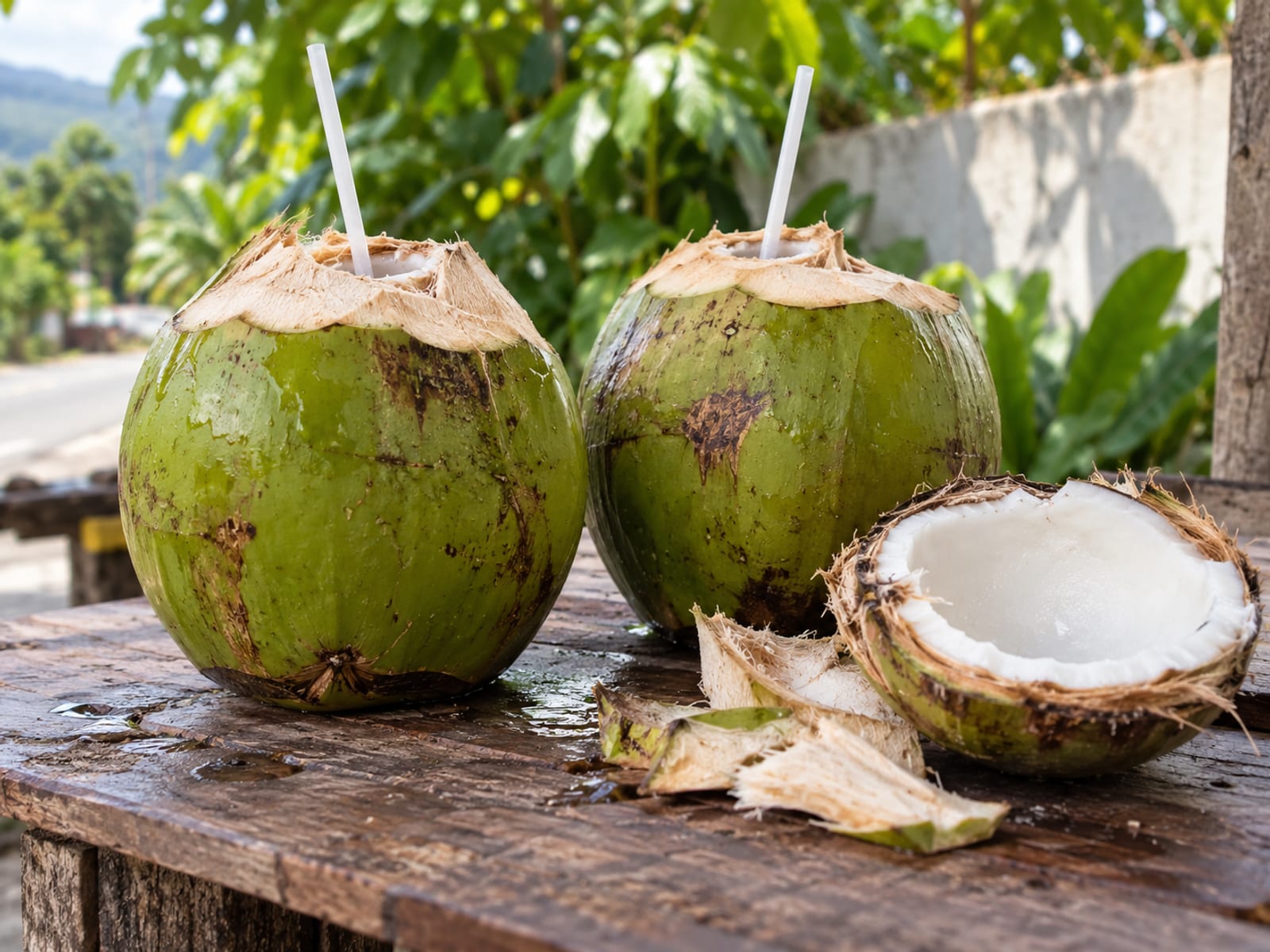 Coconut water comes from a young green coconut, and the soft flesh is the jelly.
Sky juice is shaved ice with syrup or cane juice, traditionally served in a plastic bag with a straw. Related frozen drinks are often sold as bag juice. Cold drinks are a good companion to spicy food, but a cold drink does not cancel the heat on its own.
How to order at a roadside stall
Say what you want before the vendor starts cooking. Tell the vendor if you want less pepper, the sauce on the side, a particular piece of chicken or fish, and the current price. Vendors may sell a quarter portion, a bag, a plate or a pound, so name the size you expect.
Keep the cash in small notes. Roadside vendors, markets, route taxis and small stalls commonly operate with cash. Cards are more likely to work at established restaurants, hotels, supermarkets and larger patty shops. Some market vendors are introducing payment systems, but card acceptance is still not universal.
Treat a US-dollar price as valid only when the vendor quotes it in US dollars. Otherwise, expect the price in Jamaican dollars.
What to pay
Prices change, but a few published examples give you a sense of the range. At Potwah Diner and Bar on Hillview Avenue in Kingston, curried goat was J$1,500 (about US$9.43) in a June 2025 Jamaica Observer feature. That is a sit-down diner price, not a roadside price. Lonely Planet gave J$1,200 (about US$7.55) as a 2024 reference point for a quarter-pound jerk chicken portion, while noting that prices vary by establishment.
One menu is not an island average, so treat these as reference points and check the price in front of you. A tip is also separate from the menu price. Ask the price before you order, especially where the portions are not on display, and find out whether the quote is for a piece, bag, plate, pound or quarter portion.
Heat, hygiene and the permit question
Scotch bonnet can be very hot. Find out whether the pepper sauce is mixed into the food or served on the side, so you can set the heat yourself. Pepper shrimp, jerk sauce and escovitch-style pickles can be especially spicy too. Coconut water, bottled water and other cold drinks are practical companions, but a drink will not neutralise pepper heat. Fresh patties can have a very hot filling, so let them cool before you bite.
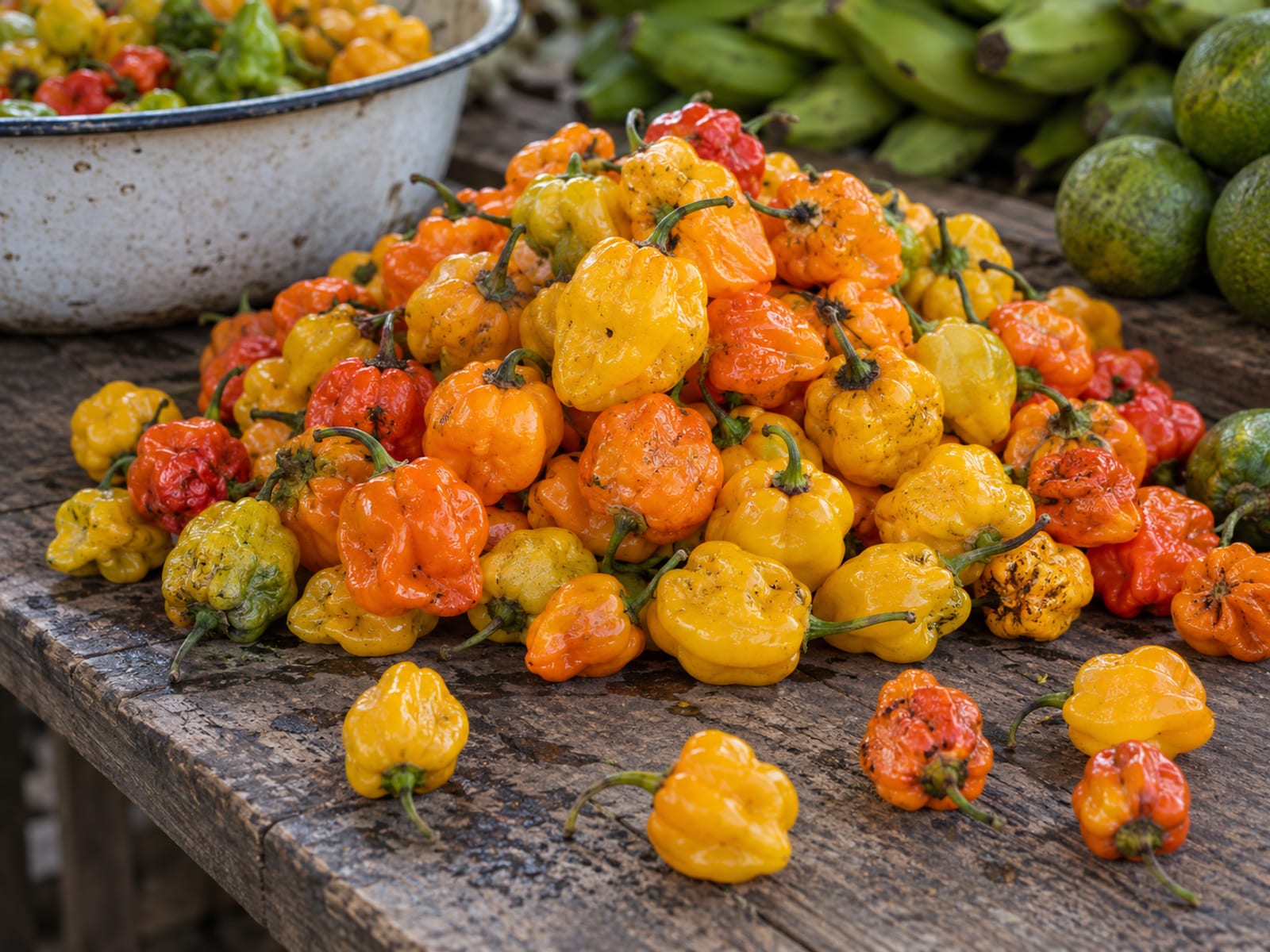 Scotch bonnet can be very hot, so ask for pepper sauce on the side.
Jamaica's Ministry of Health requires food handlers who prepare or serve food to the public to hold a valid food-handler permit. The Jamaica Information Service advises looking for a valid Food Handler's Permit, a Food Establishment Licence and a Public Health Act Food Handling Certification where those apply. A visitor can also request to see a permit from an itinerant vendor. From January 1, 2026, permit validity is two years, so check the dates on the permit itself.
Choose food that is cooked through and served hot. Busy stalls where the food is turning over are a better bet than food that has sat out for a long time. Look for clean utensils, covered food and protection from dust and flies, and avoid food that has sat uncovered for an uncertain time. Find out when the shrimp or fish was cooked. Carry bottled water if you are unsure of the water source, and use hand sanitizer before you eat, especially when you eat with your hands.
Popularity is not proof of current sanitary compliance. The Boston closure in 2024 showed that a famous destination can still have serious problems, so the vendor in front of you matters as much as the reputation of the area.
Common questions
What are the must-eats in Jamaica?
Start with jerk chicken or pork, a beef patty with coco bread, roast yam with saltfish, fried fish with festival and roast corn. Ackee and saltfish is usually a breakfast dish, and it is one of the country's defining foods. Pepper shrimp is worth a stop in Middle Quarters, St Elizabeth.
What is something you can only get in Jamaica?
No single street food is exclusive to Jamaica, because Jamaican dishes are now sold abroad through the diaspora, restaurants and packaged-food businesses. The strongest case is the setting. Jerk cooked over pimento wood at a traditional jerk centre, or fresh pepper shrimp bought from a roadside vendor in Middle Quarters, is the experience to seek out.
What do Jamaicans like to snack on?
Patties are the most widely available snack, with beef, chicken, vegetable and cheese fillings all common. Roast corn, roast yam, coconut water, sky juice, peanuts and bun and cheese are everyday choices too. Pepper shrimp is a regional snack, and Middle Quarters is its best-known home.
Is Jamaican street food safe to eat?
It can be, but safety depends on the vendor, the food and the conditions on the day. Look for a valid food-handler permit, food cooked through and served hot, clean utensils and covered food. A famous name is no guarantee, and Boston Jerk Centre was closed by health authorities in September 2024 after public-health breaches.
What does licky licky mean in Jamaica?
Licky licky is Jamaican Patois for someone who is fawning, flattering or eager to get something from another person, and it can also describe greedy behaviour. It is not mainly a food word, although it can describe someone who is always after food or treats. Among friends it can be playful, but said to a stranger it can sound insulting, so keep it for people who know you.